
Post-inflammatory hyperpigmentation on melanin-rich skin
Post-inflammatory hyperpigmentation, or PIH, is the dark mark skin leaves where it was inflamed: a pimple, a rash, a razor bump, a burn. Deeper skin tones get it more often. In one acne study, 65.3% of African American patients developed it. Brown marks can take months to years to fade. Blue-gray ones can last far longer.
Published · Written by Kay Woodson · Results vary.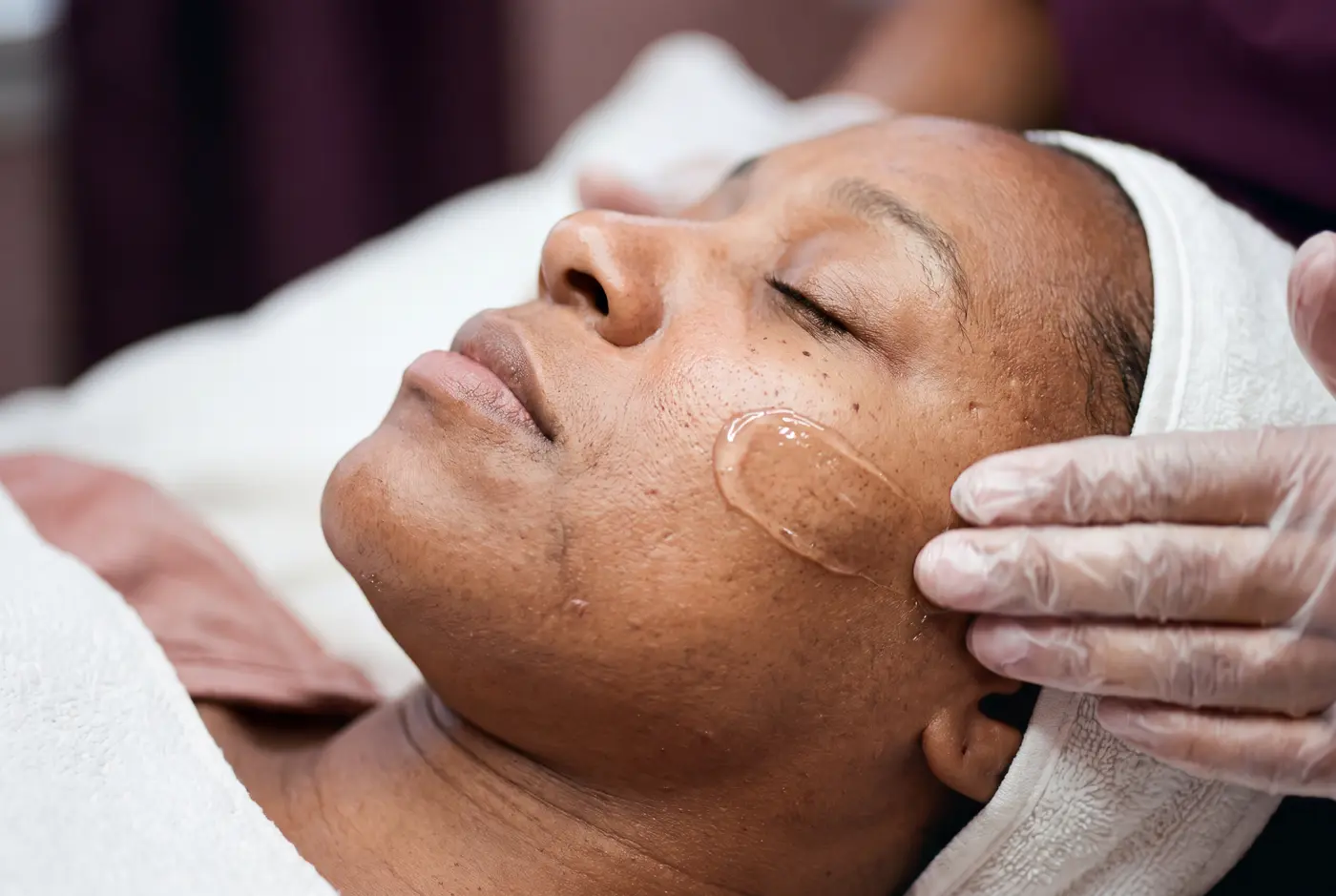
What happens in the skin after a breakout?
Inflammation is a signal, and pigment cells answer it. A 2010 review by dermatologists Eric Davis and Valerie Callender explains that chemical messengers released during inflammation push melanocytes to make more melanin and pass it to nearby skin cells. The pimple heals. The extra pigment stays behind.
Sometimes the pigment drops deeper. When inflammation damages the bottom row of the outer skin, melanin spills into the layer below, where cleanup cells swallow it and hold on to it. That deeper pigment is why some marks look blue-gray instead of brown, and why they behave so differently over time.
Brown or blue-gray: what the color tells you
A rough guide from the Davis and Callender review. Only a dermatologist can say for certain how deep a mark sits.
| Upper-layer PIH | Deeper PIH | |
|---|---|---|
| Color | Tan, brown or dark brown | Blue-gray |
| Where the pigment sits | In the outer layer of skin | In the layer below, held by cleanup cells |
| Without treatment | Months to years to clear | May never fully fade, or fade over a very long time |
| Who to see | Home care, a facial, or a dermatologist | A board-certified dermatologist |
The Skin of Color Society also describes PIH as tan, brown or purple.
Why does deeper skin hold on to marks?
It comes down to how much pigment the skin makes, more than to race. Davis and Callender point to studies in Singapore where PIH was more common in Malay and Indian patients, who tend to have deeper skin, than in Chinese patients. Their reading: the degree of pigmentation matters most.
The numbers in American clinics tell the same story. In the 2002 acne study they cite, 65.3% of 239 African American patients and 52.7% of 55 Hispanic patients developed acne-related PIH. In a 1983 survey, pigment problems other than vitiligo were the third most common reason African American patients saw a dermatologist, at 9%, against seventh place and 1.7% for white patients.
What causes post-inflammatory hyperpigmentation?
The Skin of Color Society and the Davis and Callender review list these triggers. Anything that inflames the skin can belong here.
- Acne, named first in both lists. The AAD adds that picking or popping pimples raises the risk of scarring.
- Eczema and allergic or irritant rashes, including a reaction to a new cleanser or fragrance.
- Razor bumps. In one study of 71 African American and Hispanic patients, 90.1% reported dark marks. See razor bumps and ingrown hairs.
- Bug bites, burns, cuts and infections such as impetigo.
- Psoriasis and lichen planus.
- Cosmetic procedures and harsh products, which is why exfoliation on darker skin should start gently.
A realistic timeline for a dark mark
- 1While the cause is activeTreat the breakout or the rash first. The Skin of Color Society is plain about it: the skin problem behind the color has to be treated before the color can clear. Fading creams on top of active acne chase a moving target.
- 2The first weeksProtect and leave it alone. Sunlight can make PIH darker, so use sunscreen and cover the area when you can. No scrubs, no picking. Davis and Callender note that starting treatment early may help a mark clear sooner.
- 3Two to three months inTake stock. In the Davis and Callender treatment table, a plan is reviewed after 8 to 12 weeks, with more treatment if needed. A mark that is clearly lighter is on its way.
- 4Past a yearA brown mark can still be fading. A blue-gray mark that has not changed is the one to show a dermatologist.
Can you prevent new marks?
Mostly by preventing the inflammation itself: treating acne early, choosing products that do not sting, and handling razor bumps before they turn into marks. The AAD's acne advice for darker skin starts with treating the acne and the dark spots together, since clearing breakouts removes what causes the spots.
For sun, there is evidence. A 2025 systematic review of 14 studies and 369 patients found that only sunscreen consistently prevented PIH. In the sunscreen-only group, 61 of 62 patients avoided it. The limits matter: nearly every case followed laser treatment, every patient was of Asian descent, and none had the deepest skin type. It is a good reason for daily sunscreen, not a promise.
What helps a mark fade
The Skin of Color Society lists hydroquinone, retinoids, azelaic acid, glycolic acid and kojic acid as ingredients that may speed fading, and says microdermabrasion and light chemical peels can also help. Hydroquinone now needs a prescription, according to the AAD.
The AAD's acne page for darker skin carries a warning that matters here: even at-home peels and microdermabrasion can leave lasting dark marks and light spots. Davis and Callender add that camouflage makeup can ease the wait. For the full comparison of options, from sunscreen to laser, see hyperpigmentation and dark spots.
Where Karisma Esthetics fits
Kay Woodson does not diagnose skin conditions or prescribe. For a mark from a breakout that has already healed, the Advanced Facial is $225 for about 90 minutes and can use microdermabrasion or a superficial peel, the two studio tools the Skin of Color Society names for PIH. If breakouts are still active or the skin is irritated, the $125 Signature Facial comes first.
Since PIH starts with inflammation, Kay plans every step to cause as little of it as possible. She keeps extractions light and does not go back over the same blemish again and again, because that kind of repeated handling is exactly what can leave a mark. Microdermabrasion strength is matched to each person's skin, not set once for everyone.
Darker marks after a peel are a known risk on deeper skin, which is why the peel and microdermabrasion guide for dark skin walks through test spots, timing and the questions to ask.
When a dark mark is not just a mark
Book a board-certified dermatologist for a blue-gray patch that has not changed in a year, for pigment that appears suddenly or spreads with no breakout or rash behind it, and for any dark spot that grows, bleeds or changes shape. Active cystic acne also belongs with a dermatologist, because deep breakouts leave deeper marks.
Questions about PIH on darker skin
How long does post-inflammatory hyperpigmentation last on dark skin?
Brown marks in the outer skin can take months to years to clear without treatment, according to Davis and Callender. Blue-gray marks that sit deeper can last much longer or stay. Treating the cause and protecting the skin from sun shortens the wait.
Do dark spots on dark skin go away naturally?
Many do, slowly, once the breakout or rash behind them has stopped. The Skin of Color Society says PIH can take months or even years to go away completely.
What makes hyperpigmentation worse?
Sun, and more inflammation. The Skin of Color Society notes sunlight can darken PIH. Picking, scrubbing and stinging products add inflammation, and on deeper skin even at-home peels can leave lasting marks, per the AAD.
Is PIH the same as an acne scar?
No. PIH is flat color you can see but not feel. A scar changes the surface. See acne scars for how to tell them apart.
- Davis EC, Callender VD. Postinflammatory hyperpigmentation: a review of the epidemiology, clinical features, and treatment options in skin of color. J Clin Aesthet Dermatol. 2010;3(7):20-31, July 2010, read October 29, 2026
- Post-Inflammatory Hyperpigmentation (PIH), Skin of Color Society, Chere Lucas, MD, no date shown, read October 29, 2026
- Mar K et al. Prevention of post-inflammatory hyperpigmentation in skin of colour: a systematic review. Australas J Dermatol. 2025;66(3):119-126, 2025, read October 29, 2026
- 10 tips for clearing acne in darker skin tones, American Academy of Dermatology, no date shown, read October 29, 2026
- Melasma: Diagnosis and treatment, American Academy of Dermatology (hydroquinone prescription status), last updated February 15, 2022, read October 29, 2026
- Karisma Esthetics booking page and prices, GlossGenius, checked October 29, 2026